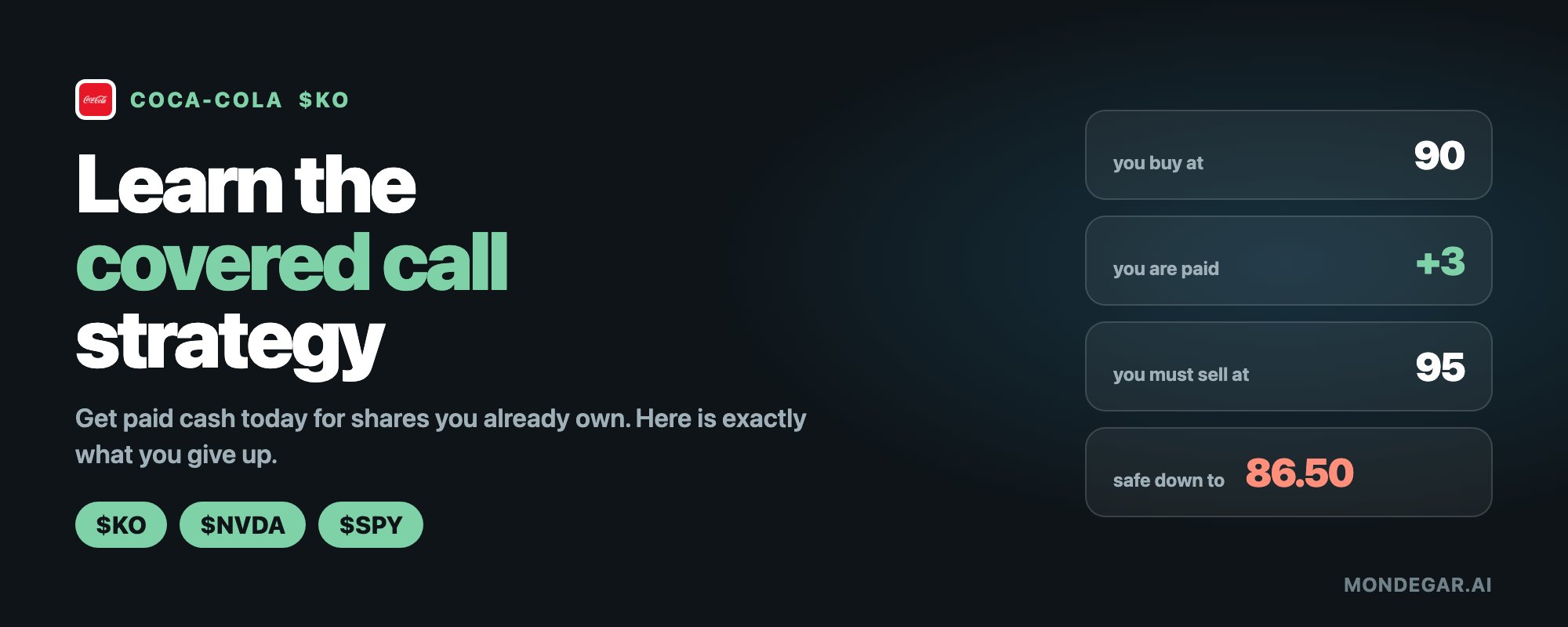
A covered call is a way to get paid cash today for shares you already own.
You give something up to get that cash. This guide shows you exactly what, using Coca-Cola $KO and round numbers you can follow in your head.
Here is an example to start with
$KO trades around 89. To keep the sums easy, picture it at 90.
You buy 100 shares at 90. That costs 9,000 dollars.
Somebody pays you 300 dollars right now. In return you promise: if $KO is above 95 in two months, I will sell you my 100 shares at 95.
The 300 dollars is yours to keep no matter what happens next.
$KO also pays a 50 cent dividend while you hold it. That is another 50 dollars.
That is the whole trade. Everything below explains what happens after.
Why is it called covered
Because you already own the shares.
You promised to sell 100 shares. You have 100 shares. So you can always keep the promise.
If you made that promise without owning them, it is called uncovered. The stock goes to 200 and you have to go buy it at 200 to keep your word. That can wipe you out.
Covered cannot. You already have what you promised. That is why beginners are told to learn this one first.
Think of your house
Your house is worth a million dollars.
A man says: take 30,000 dollars, keep it whatever happens. In return, if I come back within a month, you must sell me the house for a million and eighty.
He never comes back. You keep the house and the 30,000.
He comes back. You sell for a million and eighty, and you still keep the 30,000.
The house jumps to a million and a half. You still sell for a million and eighty. That is the cost.
A covered call is that deal, with 100 shares instead of a house.
The 300 dollars lowers what you paid
You paid 90 a share. You were handed 3 a share.
So you really paid 87 a share.
That is the simplest way to think about this whole strategy. It is not free money. You bought $KO cheaper.
What if the stock goes up
$KO goes to 105.
You must sell at 95. So you make 5 a share on the stock, plus the 3 you were paid, plus the 50 cent dividend. That is 8.50 a share, or 850 dollars.
If you had done nothing, you would be up 1,550.
You are 700 dollars worse off. Not money out of your pocket, but money you could have had. That is what the 300 dollars cost you.
What if the stock stays at 90
Nobody makes you sell. You keep the shares, the 300, and the 50.
You are 300 dollars better off than somebody who just held.
This is the case the strategy is built for.
What if the stock goes down
$KO falls to 80.
You lost 10 a share, which is 1,000 dollars. But you were handed 350. So you are down 650.
Somebody who just held is down 950.
You still lost money. You just lost less. The 300 is a cushion, not a shield.
All of it in one table
Read the last column. You win in five rows out of seven.
The rows you lose are the ones where the stock runs. And there is no limit to how bad that gets. $KO at 120 and you are still selling at 95.
The two numbers to work out first
98. That is 95 plus the 3 you were paid.
Below 98 this trade beat holding. Above 98 holding beat this trade. So work that number out before you place any covered call, and ask yourself honestly whether the stock gets past it. If you think it does, do not do the trade.
86.50. That is 90 minus the 3.50 you were handed.
$KO can fall all the way to 86.50 and you have still not lost a penny. That is a 3.9 percent cushion.
Look at 86.50 before you look at how much you get paid. It tells you how wrong you are allowed to be.
The big number on the screen is not your money
Every website will show this trade as 59 percent.
You will get 9.8 percent.
Here is where 59 comes from. The trade lasts two months. Two months is a sixth of a year. So they take your 9.8 percent and multiply it by six.
It answers a question you cannot act on: what if this exact trade came back six times in a row. It will not.
And the shorter the trade, the bigger that number gets. A one week trade is multiplied by 52. So sorting a list by that number floats the shortest and riskiest trades to the top. It will feel like research while you are doing it.
Say it the honest way. 9.8 percent over two months. Now you can compare it to a savings account.
Now the dividend
$KO pays you 50 cents a share. To get it you must own the shares on a specific day.
The ex-dividend date is the day the stock starts trading without the dividend attached. The record date is the day the company checks who owns the shares.
Since May 2024 these are the same day. Older articles say the ex-date comes a day earlier. That is out of date.
So: buy no later than the day before the ex-dividend date. Buy on the day itself and you get nothing.
Buying shares just to collect a dividend is called dividend capture. Doing it while also selling a call is what income investors actually do.
Two things nobody tells beginners about dividends
One. The stock drops on the ex-dividend date.
It opens lower by roughly the dividend. $KO pays you 50 cents and opens about 39 cents lower. So you did not gain 50 cents. You gained about 11.
That 11 cents is the entire profit in dividend capture. For most people the trading costs eat it.
Two. You were never paid extra for the dividend.
The 300 dollars you were handed already had the dividend subtracted from it. The market prices it in from the moment the option is quoted.
So you cannot collect the payment, the dividend and the upside all at once. It is a trade, not a stack.
Can they take your shares early
Yes, and this surprises people.
The man who paid you 300 dollars does not have to wait two months. He can take your shares any day he likes.
He has a very good reason to take them the day before the ex-dividend date. If he owns them that morning, he gets the 50 cents instead of you.
This only becomes a real risk once the stock has climbed past 95. Say it is at 98.
The one check that tells you
Most articles give you a formula here. You do not need one.
On the afternoon before the ex-dividend date, look at what people are bidding for your call. If that bid is below the share price minus 95, your shares are going tonight.
$KO is at 98. Minus 95 is 3.
If the call is bidding less than 3, somebody is about to take your shares. They can buy the call for under 3 and turn it straight into 3 dollars of stock. Free money, and somebody always takes free money.
You can read that off your screen in five seconds.
To stop it, buy the call back that same afternoon. Not the next morning. The decision is made after the close and you find out overnight, so by then it is done.
But losing the dividend may be the better outcome
This is the part that changes how you think about all of it. Work the same trade both ways.
You make 50 cents less if they take your shares early. But you make it in a third of the time, and then your money is free to do something else.
So ask this before you place the order: does being taken out early pay better per day than holding on?
If yes, then neither outcome can upset you. The thing every article calls a risk has stopped being one.
If no, leave that trade alone.
What about tax
Dividends get the low tax rate only if you held the shares more than 60 days around the ex-dividend date.
Selling a call that is already below the share price stops that clock. Not just a very low one. Any call priced below where the stock is trading.
Our 95 call is above 90, so we are fine. The clock keeps running.
But sell the 88 call instead, which is below 90, and the clock stops. If you had not already held those shares 60 days, the dividend you did this trade to collect is now taxed at your normal income rate.
The strategy can wreck the tax status of the dividend it exists to collect.
None of this applies inside a retirement account. If you plan to run this regularly, that is where it belongs.
Does it actually work
There is a public index that has done exactly this trade on the S&P 500 $SPY, every single month, since 1986. It is the honest answer to the question.
Forty years of this did not beat simply owning the market.
What it did do was this: you gave up about 2.5 percent a year, and got a third less bumpiness and a much smaller worst case.
That is a real trade and a sensible one if a calm ride is what you want. It is not free money and it is not skill. Anybody telling you otherwise is selling something.
What can go wro
Almost none of these are about being wrong on the company
When should you use it
On a solid stock you think will move sideways, owned by somebody who would genuinely be happy to sell at 95.
Think of it as getting paid to wait while you sell something you were going to sell anyway.
This is why people do this on $KO and not on $NVDA. Nvidia can add 30 percent in two months, and then you are the person who sold it at 95. The pain never comes from a crash. It comes from a rally that happens without you.
And decide your exit before you enter. Then stop watching the price of a stock you have already promised to somebody else.
A real one, from today
Now that the shape is clear, here is an actual row from our screen this afternoon. Ugly numbers, exactly the same six things.
Best Buy $BBY at 87.49. Sell the October 85 call and you are paid 5.00. A 96 cent dividend lands inside the window.
Your real cost is 82.49. You lose nothing above 81.53, which is 6.8 percent down. You collect 4.2 percent over six weeks, and the website will call it 34.9.
And note the trap we just covered. 85 is below 87.49, so that call stops the dividend clock.
Cost, cushion, crossover, payment, dividend, deadline. Six numbers, every single time.
See it for yourself
Every trading day we run this across the S&P 500 and work out what you get paid, the price you would have to sell at, whether a dividend lands inside the window, whether your shares can be taken early, and how far the stock can fall before you are down.
Covered Calls, today's list with all of it already worked out: www.mondegar.ai/screeners/covered-calls
Any stock, with every fund that owns it and what they did last quarter: www.mondegar.ai
Money Flow, which companies institutions are moving into and out of: www.mondegar.ai/money-flow
Mondegar.ai
Note on the data: the $KO example uses round numbers so the arithmetic can be followed without a calculator. Coca-Cola traded near 89 on 3 September 2026 and pays roughly 51 cents a quarter. The Best Buy position is a real row from our covered call screen on the afternoon of 3 September 2026. Returns are worked out on the money actually at risk, which is the share price less the payment received. American settlement moved to one business day on 28 May 2024, which is why the ex-dividend and record dates now fall on the same day. The share price falling by less than the dividend was first measured by Elton and Gruber in 1970 and repeated many times since, with the drop averaging roughly 78 percent of the dividend. The 60 day holding rule for dividend tax rates is in section 246(c) of the Internal Revenue Code, and the suspension caused by selling an in-the-money call is in section 1092(f). The long run comparison uses the Cboe S&P 500 BuyWrite Index against the S&P 500 total return index, from 20 June 1986 to 31 July 2026. Option prices move all day, so these figures describe that afternoon and not today. This is built to teach, it is not advice, and options can lose you money.