Be an Informed Investor Know how it can impact your portfolio
The Fed decides on Wednesday the sixteenth of September at two in the afternoon New York time.
The market prices a quarter point RISE at about seventy eight percent. A cut is not on the table at all.
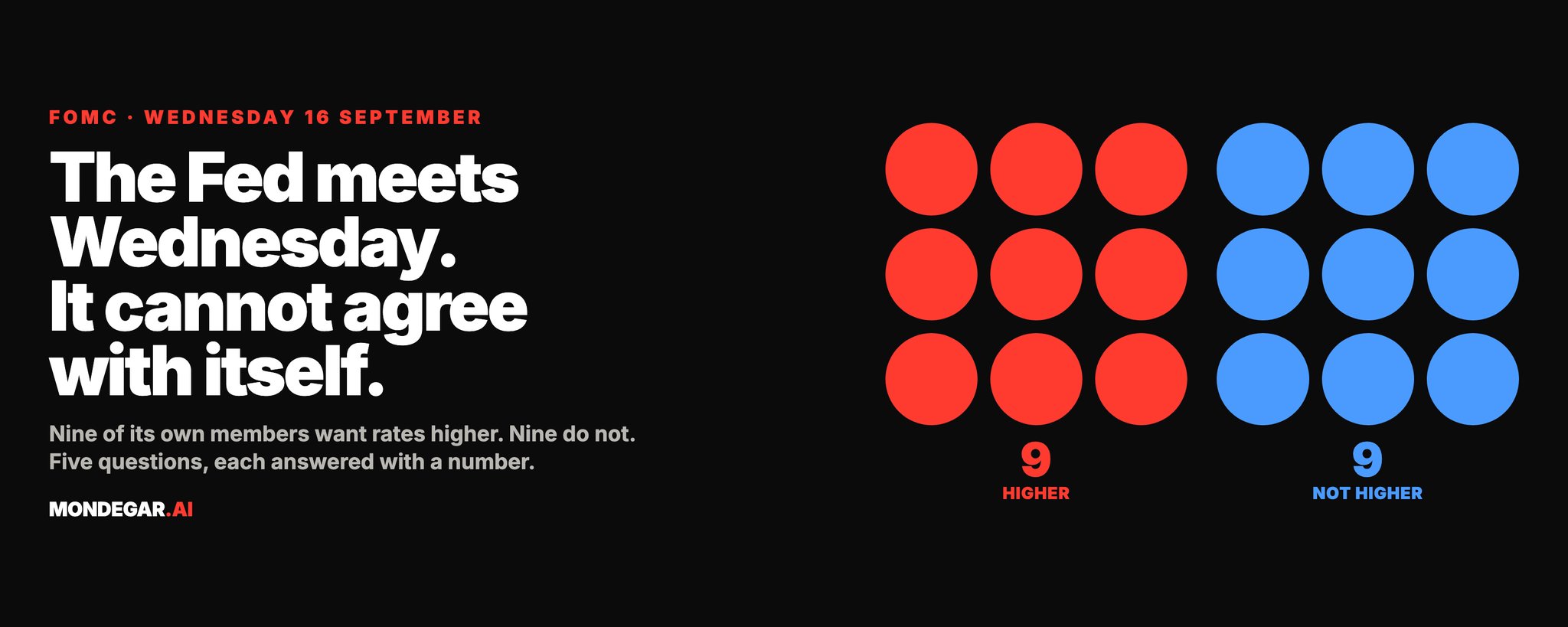
The committee is split down the middle. Of the eighteen policymakers who submitted a June forecast, nine put rates ABOVE today's range by the end of this year, eight put them unchanged, and one put them lower. That is the Fed's own June dot plot, published at federalreserve.gov/monetarypolicy/fomcprojtabl20260617.htm, and you can count the dots yourself.
The textbook trade did not work. Over the thirty days in which the ten year yield actually rose, big banks fell, regional banks fell as hard as small companies, and six of eight large insurers fell. Cash was the only reliable winner.
The losers were consistent: property companies, utilities and small companies. The ones who borrow, and the ones who pay you to own them.
Three things to check before Wednesday. Which of your holdings carry floating rate debt, because their interest bill moves on the day. What you own purely for income, now that a government bond pays near five percent. And how much you hold in smaller companies, which have already taken the heaviest hit.
THE SHORT VERSION
The market prices a quarter point RISE at about seventy eight percent. A cut is not on the table at all.
The Fed itself is split. Of the eighteen policymakers who submitted a forecast in June, nine said rates end this year higher and nine said unchanged or lower.
The textbook trade did not work. Over the thirty days in which the ten year yield actually rose, big banks fell, regional banks fell as hard as small companies, and six of eight large insurers fell. Cash was the only reliable winner.
The losers were consistent: property companies, utilities and small companies. The ones who borrow, and the ones who pay you to own them.
Before Wednesday, check three things: which holdings carry floating rate debt, what you own purely for income now that a government bond pays near five percent, and how much you hold in smaller companies.
The market now puts a rate rise at close to eighty percent. That is the easy part. The five arguments underneath it are the ones worth your time, and they are the ones real investors are actually having.
Most previews of a Federal Reserve meeting tell you what the Fed will do. This one will not pretend to know. Instead it takes the five questions that investors are genuinely arguing about this week, and answers each one with a number.
Here is the meeting in one line. On Wednesday the sixteenth of September at two in the afternoon New York time, the Federal Reserve decides whether to raise interest rates for the first time this year.
And here is why it is not simple. Nineteen policymakers sit on the committee and publish forecasts, seven governors and the twelve reserve bank presidents, though only twelve of them vote on the day. In June, eighteen of the nineteen submitted a forecast. Chair Warsh did not, which is itself a signal and we come back to it. Of those eighteen, nine said rates would end this year higher. Nine said unchanged or lower.
A dead heat, inside the room that decides.
FIRST, THE THING EVERYONE GETS WRONG
The Fed sets one interest rate. Almost every other rate in the country follows it. Your mortgage, your car loan, what a company pays on its debt, what your savings account pays you.
That rate has been three and a half to three and three quarters percent since December. It has not moved in nine months.
On Wednesday it either goes up by a quarter of a point, or it stays.
Now notice what nobody is discussing. A cut. For two years the whole argument was about how fast the Fed would cut rates. That argument is finished. The conversation has flipped to whether they need to go the other way, and most people have not adjusted to that yet.
On Polymarket, where people bet real money and roughly one hundred thirty seven million dollars has changed hands on this one question, a quarter point rise is priced at seventy eight and a half percent. No change is priced at twenty and a half. Everything else, a cut or a larger move, prices at under one percent combined.
Two weeks ago the same question was a coin flip. One speech moved it.
QUESTION ONE. IT IS ALREADY PRICED IN, SO WHY WOULD THE MARKET MOVE?
This is the argument you will hear most often, and both sides of it are reasonable.
The case that it does not matter is simple. If eight out of ten people already expect a rise, the price of everything already reflects a rise. The announcement tells the market nothing it did not know. No surprise, no move.
The case that it moves anyway rests on something subtler. Markets do not price one outcome, they price a distribution. Twenty percent of the money is still positioned for no change. When the announcement lands, that twenty percent has to adjust, and adjusting means trading.
Here is the honest answer. The decision is largely priced. What is not priced is the language. Prices respond to the gap between what happens and what was expected, and the expectation includes not just Wednesday's number but the path after it. A rise that comes with a signal that it is the last one is a different event from the identical rise with a signal that more are coming.
Which is why the second half of the announcement matters more than the first.
QUESTION TWO. WHAT IF THEY DO NOT HIKE?
This is the most interesting question of the five, and the one fewest people are prepared for.
The instinctive reading is that no rise is good news. Cheaper money for longer. Shares up.
There is a serious argument the other way. If the Fed has spent a month letting the market price a rise at nearly eighty percent, and then does not deliver, it invites an uncomfortable question: what do they know that we do not? A central bank that flinches at the last moment is either signalling economic weakness it has not disclosed, or signalling that it is not willing to act on its own inflation target.
Either reading is worse for markets than the rise itself.
There is a third possibility that is less dramatic and probably more likely. A hold accompanied by forecasts pointing higher is a hawkish outcome dressed as a dovish one. Nothing changes today, everything changes in the messaging.
So the useful frame is not raise equals bad and hold equals good. It is: does Wednesday's combination of decision and language tell you the Fed is nearly finished, or that it is just getting started.
QUESTION THREE. WILL POLITICS STOP HIM?
Kevin Warsh became Fed chair this year. Midterm elections are coming. It is a fair question whether a chair raises borrowing costs on households in an election season.
The counter-argument is that the cost of being seen to bend is higher than the cost of the rise. A Fed chair whose first serious decision looks politically timed spends the rest of his term being disbelieved, and a central bank that is disbelieved has to raise rates further later to get the same effect.
Nobody outside the room knows. But there is a measurable proxy for how united the committee is, and almost nobody is looking at it.
There is a separate market on how many policymakers will vote against whatever is decided. It prices a twenty eight percent chance that nobody dissents. Which means seventy two percent of the money expects at least one member to vote against.
A united Fed is the long shot here. That matters because a narrow vote tells you the argument continues into the next meeting, whatever happens on Wednesday.
For context, a recent meeting split eight to four, the most disagreement since 1992, with members disagreeing about the direction rather than merely the timing.
QUESTION FOUR. WILL THE TEN YEAR HIT FIVE PERCENT?
This is the one question in the list that is close to already answered.
The yield on the ten year US government bond is four point nine seven percent. Three basis points from five, and at a three month high. Over the last thirty days the five year yield rose forty two basis points and the ten year rose twenty nine.
Bond yields rise when investors expect higher interest rates. Nobody waited for the announcement. The bond market has been voting for a month.
And somebody paid for that. Over the same thirty days, smaller American companies fell four point six percent as a group. Utility shares fell three point three percent. Property shares fell two point four percent. The S and P five hundred fell one point one percent.
Those three are not a random selection. Smaller companies borrow more at floating rates, so their interest bill rises the day rates do. Utilities and property are owned largely for their dividends, and a dividend now has to compete with a government bond paying nearly five percent with no risk to the coupon.
"The rate-sensitive corners of the market paid for this decision before a single vote was cast."
The five percent level matters less as a number than as a threshold in people's heads. Above it, the argument for holding shares purely for income gets harder to make, and every valuation model in the market gets a worse discount rate.
QUESTION FIVE. IS THE CASE FOR RAISING EVEN GOOD?
Worth checking, because a lot of people are treating the rise as obviously correct.
Inflation came in at three point four percent for August, well above the Fed's two percent goal. But that is not the number the Fed steers by. The Fed watches core inflation, which excludes food and petrol because those swing on weather and wars rather than on interest rates. Core inflation in August was two point four percent.
Two point four is not two. But it is close enough that a sensible person can argue the job is nearly done.
So why raise at all? The answer came from Warsh in a speech on the twenty eighth of August. Over the previous six months, he said, forty nine percent of the things the Fed measures were still getting more expensive at more than three percent a year. Half the basket is still hot even though the average looks calm.
"We must be confident that underlying inflation is moving to our objective, clearly and at sufficient speed. Otherwise, we have work to do."
Then the jobs report landed. Employers added one hundred sixty two thousand jobs in August against an expectation of fifty three thousand, and against a recent monthly average of thirty one thousand. Roughly five times trend. An economy hiring that fast does not obviously need cheaper money.
The case for doing nothing is also serious. Core inflation at two point four percent is the lowest of this cycle. Unemployment held at four point one percent, so nothing is breaking. Wages rose three point one percent over the year, which is not the runaway pay growth that accompanies real inflation trouble. And rate rises work slowly, with the effect on prices showing up a year or more later, so raising into an economy that is already cooling can cause the recession you were trying to avoid.
Both sides are reading the same fortnight of data and weighting it differently. That is why it is close.
WHO ACTUALLY BENEFITS WHEN RATES RISE
Ask this question anywhere and you get the same answer: banks, insurers, brokerages. They earn more on the spread between what they pay depositors and what they charge borrowers, and insurers reinvest their premiums at higher yields. It is in every guide ever written on the subject.
We checked it against the last thirty days, which is the exact window in which the ten year yield actually rose twenty nine basis points. If the textbook is right, this is when it should show.
It did not show. Big banks fell one point two percent. Regional banks fell four and a half percent, as hard as small companies. And of eight large insurers we looked at, six fell: Chubb, Prudential, Aflac, Allstate, AIG and Cincinnati Financial. Only Progressive, up four point nine percent, and Travelers, up one point seven, rose.
The only thing that reliably went up was cash. Short dated Treasury bills returned a positive three tenths of a percent while almost everything else fell.
Why the textbook missed. Banks earn more on loans when rates rise, but they also pay more on deposits, and savers now move money to whatever pays most within days. Regional banks carry long dated bonds that lose value as yields climb. And the insurance benefit is slow, because premiums get reinvested gradually rather than all at once, so it shows up over years rather than in a month.
The honest conclusion is narrower and more useful than the textbook one. Rising rates do not reliably hand you a winning sector. They reliably make cash competitive. A government bond paying close to five percent is now the yardstick every other investment is measured against, and that is the real change of the last month.
One caveat, stated plainly. Thirty days is thirty days. It is a snapshot of one move, not a law, and the same names could behave differently over a year. Treat it as a reason to check your own holdings rather than as a trade.
WHO GETS HURT
This side is much more consistent, and it is where the damage has already landed.
Simon Property fell six point one percent. Southern Company fell five. VICI Properties fell four point eight. Smaller companies as a group fell four point six. Realty Income fell four and a half, as did regional banks. NextEra Energy fell three point three.
Three kinds of company sit on that list, and it is worth knowing which kind you own.
Heavy borrowers. Property companies and utilities are built on debt, because they buy long lived assets with borrowed money. When the cost of that debt rises, the cost of doing business rises with it. Simon Property and VICI are property companies. Southern and NextEra are utilities.
Dividend payers. Realty Income is owned almost entirely for its monthly dividend. When a government bond with no risk pays close to five percent, a share paying five percent with business risk attached has to justify itself. The share price falls until the yield is high enough to compete.
Small companies. They borrow more at floating rates than large ones, so their interest bill rises the day the Fed moves rather than when their fixed rate debt matures. That is why they fell hardest as a group.
The pattern in one line. The losers are the ones who borrow and the ones who pay you to own them. If a holding of yours does both, it is doubly exposed.
AND WHAT HAPPENS EITHER WAY
If they raise. More of the above. Cash and money market funds pay a little more within weeks. Mortgage rates, car loans and credit card rates drift higher. The borrowers and the yielders take another leg down.
If they hold. The beaten-down corners bounce, because some of the fear was already in the price, but only if the language is genuinely soft. Nothing is settled and the same argument returns at the next meeting.
THREE THINGS TO CHECK BEFORE WEDNESDAY
None of these require you to guess the decision. That is the point of them. All three take a few minutes, and you can do all three on Mondegar.
One. Find out which of your companies carry floating rate debt. Their interest bill moves with the Fed, so a floating rate borrower cares about Wednesday and a fixed rate borrower mostly does not. Start with the research page for each ticker you own at www.mondegar.ai/stock/KRE, swapping in your own symbol, then confirm the detail in the debt note of the annual report. Smaller companies are far more exposed than large ones.
Two. Look at anything you own purely for income. A share yielding three percent for the dividend is now competing with a government bond paying close to five with no risk of the payout being cut. That does not make it a sell. It does mean you should be able to say why you still own it. The same research page carries the dividend, the yield and the valuation on one screen, so you can line them up against five percent in a couple of minutes.
Three. Check how much you hold in smaller companies. They have already fallen the most, four point six percent in a month. If rates rise again they are first in line. If the Fed holds, they bounce hardest
And the simplest test of all. If Wednesday's result would force you to sell something in a hurry, the position was too big before Wednesday. That is true whichever way the vote goes, and it is the only conclusion here that does not depend on guessing.
THREE THINGS TO CHECK BEFORE WEDNESDAY
None of these require you to guess the decision. That is the point of them.
One. Find out which of your companies carry floating rate debt. Their interest bill moves with the Fed. Fixed rate borrowers do not care about Wednesday, floating rate borrowers do. It is in the debt note of any annual report, and smaller companies are far more exposed than large ones.
Two. Look at anything you own purely for income. A share yielding three percent for the dividend is now competing with a government bond paying close to five with no risk of the payout being cut. That does not make it a sell. It does mean you should be able to say why you still own it.
Three. Check how much you hold in smaller companies. They have already fallen the most, four point six percent in a month. If rates rise again they are first in line. If the Fed holds, they bounce hardest. Either way, know the number before the announcement rather than after.
And the simplest test of all. If Wednesday's result would force you to sell something in a hurry, the position was too big before Wednesday. That is true whichever way the vote goes, and it is the only conclusion here that does not depend on guessing.
ONE FOOTNOTE WORTH KNOWING
A rate decision moves asset prices. It is worth knowing who holds the assets.
On the Federal Reserve's own figures, the richest one percent of American households own about half of all corporate equities and mutual fund shares. The bottom half of the country owns roughly one percent.
So the market reaction to Wednesday lands mostly on people who already own shares, while the change in borrowing costs lands on everybody with a mortgage or a car loan. That is worth holding in mind when you read that the market loved or hated the decision. The market is not the country.
WHAT TO WATCH ON THE DAY
Two o'clock, the decision. A quarter point rise, or nothing.
The same moment, the forecasts. The Fed publishes its dot plot, a chart showing where each member expects rates to go. The dots often matter more than the decision. No change today plus dots pointing higher is bad news dressed as good news.
The vote. Watch for members voting against. Seventy two percent of the money expects at least one. A close vote means the next meeting is live too.
Two thirty, the press conference. Warsh does not believe in telling markets what he plans next. At his first meeting as chair he declined to submit a rate forecast at all. Do not expect to be told what comes after this.
WHAT COULD MAKE THIS WRONG
The odds change daily. Every probability here will have moved by Wednesday, especially if another official speaks. Check them fresh.
A forecast is not a promise. Members have shifted their dots sharply between meetings. Nine to nine in June does not mean nine to nine in September.
The reaction is not the decision. Markets respond to the gap between what happens and what was expected. Rates can rise and shares can rise with them, if the language is softer than feared.
Mondegar.ai
A note on the data. The federal funds target range, the meeting date and the June Summary of Economic Projections come from the Federal Reserve. Inflation figures come from the Bureau of Labor Statistics Consumer Price Index release for August 2026, published 11 September: headline up zero point four percent on the month and three point four percent on the year, core up zero point three percent on the month and two point four percent on the year. Employment figures come from the BLS Employment Situation release for August 2026, published 4 September: one hundred sixty two thousand jobs added against a consensus of fifty three thousand, unemployment four point one percent, average hourly earnings up three point one percent over the year. The figure that forty nine percent of the price basket is running above three percent is Chair Warsh's own, from his Jackson Hole remarks on 28 August 2026. Probability figures are live Polymarket prices read on 12 September 2026 from the September Fed decision and September dissent markets, and they change daily. Treasury yields and sector performance are measured over the thirty days to 11 September 2026, with sectors represented by the Russell 2000, the utilities sector fund, the property sector fund and the S and P 500. Ownership shares are from the Federal Reserve Distributional Financial Accounts and are rounded. Nothing here is a forecast of the decision, and nothing here is investment advice.