Follow the Smart Money: Key Trends from Q2 reporting
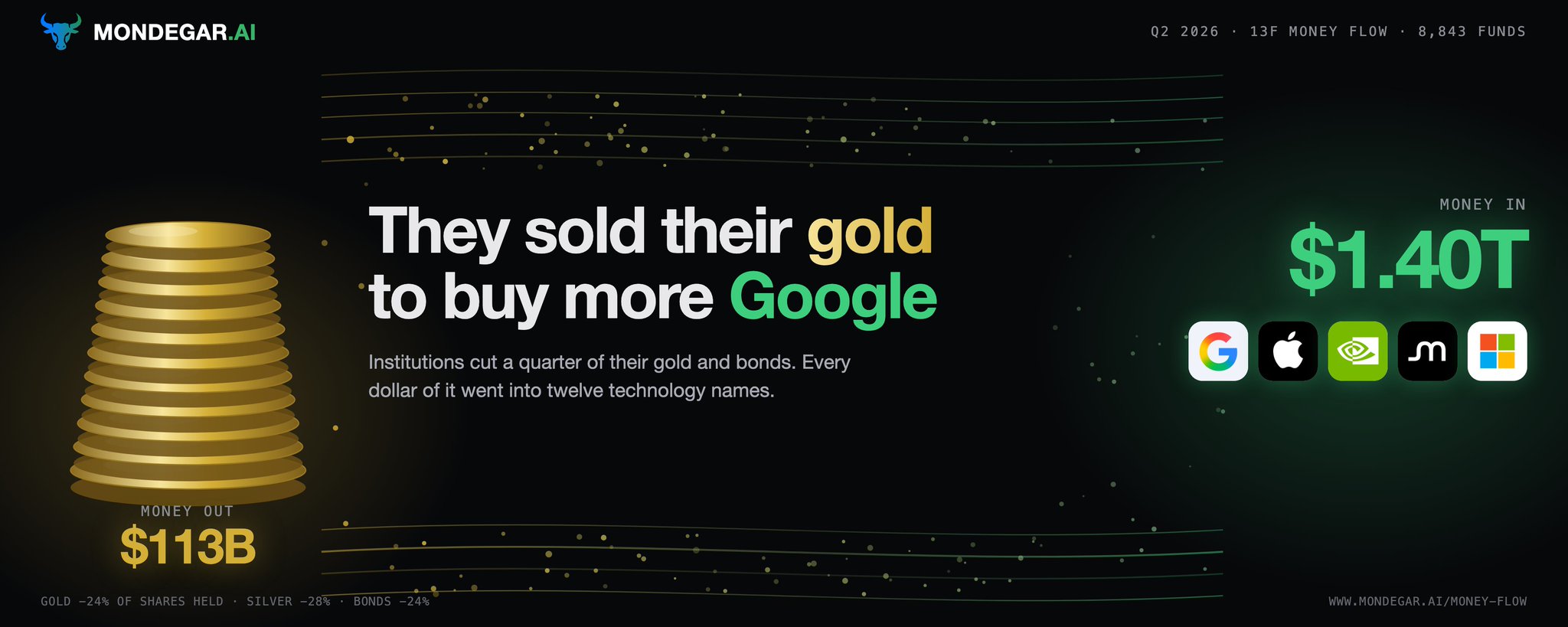
They sold their Gold to Buy More Google
Eight thousand eight hundred and forty three institutions have now reported what they owned at the end of June. Together they hold 72.36 trillion dollars of American stock, and over the quarter they moved 1.40 trillion dollars of it.
Almost every dollar went into a dozen technology companies they already owned. They paid for it by selling gold, silver and bonds.
That is the whole quarter in two sentences. The detail is worth the read, because the largest apparent move in the data did not happen at all, and most places will report it anyway.
FIRST, WHAT THEY ACTUALLY DID
Eight thousand eight hundred and forty three institutions have reported for the second quarter of 2026, covering 72.36 trillion dollars of American stock. Here is where the money went.
Alphabet took the most, at roughly 190 billion dollars of net new money. Behind it came the S&P 500 tracker SPY at 179 billion, Apple at 155 billion, Nvidia at 147 billion, and Micron at 135 billion dollars. Then Microsoft at 114 billion, Amazon at 106 billion, the Nasdaq tracker QQQ at 99 billion, the semiconductor fund SMH at 75 billion, AMD at 71 billion, Broadcom at 69 billion, and the second S&P tracker IVV at 63 billion.
Now the other side. Gold lost 41.97 billion dollars, and that is the largest genuine sale of the quarter by a wide margin. It is more than the next three combined. High yield bonds lost 13.21 billion. Silver lost 9.45 billion. Exxon Mobil lost 7.02 billion. Then a run of funds that all mean roughly the same thing: the quality factor fund QUAL at 6.65 billion, investment grade bonds at 6.37 billion, then consumer staples, international value and regional banks. The entire selling side of the board comes to 113 billion dollars, against 1.40 trillion on the buying side.
Read those two lists next to each other and you barely need the analysis.
"They sold the things you own when you are worried, and bought the things you own when you are not."
WHAT MONDEGAR READS INTO IT
There was no rotation last quarter. There was concentration. The same dozen technology companies that already dominate institutional portfolios took almost all of the new money, and the money came out of gold, silver, bonds, oil and the defensive corners of the market. Professional investors did not find a new idea. They doubled down on the old one and sold their insurance to pay for it.
1. THEY BOUGHT WHAT THEY ALREADY OWNED
The twelve largest institutional positions in America are Nvidia at 3.46 trillion dollars, Alphabet at 2.90 trillion, Apple at 2.84 trillion, Microsoft at 2.17 trillion, Amazon at 1.77 trillion, SPY at 1.58 trillion, Broadcom at 1.41 trillion, Micron at 1.30 trillion, then Meta, Eli Lilly, Tesla and AMD.
Now compare that against the buying list above. Ten of the twelve biggest buys are already among the twelve biggest holdings. This was not repositioning. It was reinforcement.
What they bought?
Key Net Buying by Funds
2. WHERE THEY DID NOT PICK A STOCK, THEY BOUGHT THE INDEX THAT OWNS THOSE STOCKS
SPY, QQQ, IVV and SMH together absorbed more than 400 billion dollars of the 1.40 trillion that moved. Every one of those funds is dominated by the same names sitting at the top of the buying list. A fund that put money into QQQ last quarter bought more Nvidia, Apple, Microsoft and Alphabet whether it meant to or not.
So the concentration is worse than the individual stock numbers suggest. The index buying is the same trade wearing a different label.
3. ALPHABET IS NOW THE MOST WIDELY HELD STOCK IN AMERICA
Nine thousand four hundred and sixty six separate institutions own a piece of Alphabet. That is nearly twice the number that own Nvidia, and Nvidia is the larger position by dollar value.
That gap matters. Nvidia is a big bet held by a concentrated group. Alphabet is a consensus position held by almost everyone. When a stock reaches that level of agreement, the interesting question stops being who is buying and becomes who is left to buy.
4. MICRON IS THE OUTLIER NOBODY IS TALKING ABOUT
Micron makes memory chips. It is not a household name. Institutions put 135 billion dollars into it last quarter, which is more than they put into Microsoft.
It now sits as the eighth largest institutional holding in the country at 1.30 trillion dollars, ahead of Meta, ahead of Eli Lilly, ahead of Tesla. If you had asked a hundred investors in January to name the eighth biggest institutional position in America, none of them would have said Micron.
5. THEY SOLD THEIR PROTECTION
What they sold
Gold is the clearest signal on the board. Institutions did not trim it. They cut the number of shares they hold by twenty four percent. Silver by twenty eight percent. Investment grade bond funds by twenty eight percent and high yield by twenty four percent.
Those are not adjustments. That is a decision, taken across thousands of funds at once, to hold less of the thing that protects you.
"You do not sell a quarter of your gold and a quarter of your bonds unless you are quite sure about what you are buying instead."
6. AND THEN SPACEX ARRIVED
One thousand four hundred and eighty two institutions now report holding SpaceX, worth 585.7 billion dollars. A quarter ago the number was zero.
To place that: if SpaceX were ranked alongside the holdings above, it would sit just behind Broadcom and ahead of Micron, Meta, Eli Lilly and Tesla. It reached that size in a single quarter, in a market where the other giants took a decade.
Three other companies appeared for the first time. Honeywell Aerospace at 48.1 billion dollars across 1,732 funds, the chipmaker Cerebras at 21.5 billion, and FedEx Freight at 13.2 billion.
New this quarter
Value held
THE TWO OBJECTIONS WE EXPECT
›WHAT THIS IS ACTUALLY FOR
Not for trading. Nothing here tells you what to do tomorrow, and any piece that claims otherwise from a filing dated six weeks ago is selling you something.
What it is for is a straight answer to one question: where is professional money actually sitting, and what did it do last quarter. The answer this time is that it sat in a dozen technology companies, it bought more of them, and it paid for that by selling its gold, its silver and its bonds.
If you own an index fund, you own that decision. It is worth knowing you made it.
NOTE ON THE DATA
Source is SEC Form 13F filings for the quarter ended 30 June 2026, covering 8,843 institutional filers and 72.36 trillion dollars of long equity positions.
Flow is measured as the change in share count valued at that quarter's price per share, never as the difference between two dollar values. A stock that rose while a fund did nothing is not a purchase, and treating it as one is the most common error in this field.
Exclusions, all of them: securities whose issuer was acquired or delisted during the quarter, corporate bonds reported alongside equities, stock splits both recorded and unrecorded, securities whose identification number changed, and single filings whose reported position is impossible against the security's own shares outstanding. Share classes filed under multiple identification numbers are combined where the ticker matches, and left separate where it does not, which keeps Berkshire Class A and Class B apart.
13F covers United States listed long equity and options only. It does not show short positions, cash, bonds held directly, foreign listings or private holdings, so no filing here represents a complete portfolio.
One correction of a common error: a 13F is not a disclosure of what a fund thinks. It is a disclosure of what a fund held on one specific day, filed up to forty five days later, by an entity that may be one of a dozen the same manager files under.
www.mondegar.ai