Situational Awareness LP filed its second-quarter 13F on 14 August 2026. The headline that will travel is that Leopold Aschenbrenner's fund has closed every one of its put positions against the AI trade. That is true. It is also the least interesting thing in the filing.
The more useful finding is what the filing history shows around that quarter. The put wall that made the fund famous appears in exactly one quarterly filing. The quarter before it, the fund held almost no puts. The quarter after it, it holds almost none again. A position that was widely described as a standing bearish thesis on artificial intelligence shows up in the public record as a single quarter.
This piece sets out what the two filings actually contain, what the six-quarter history looks like, and what a 13F can and cannot tell you about any of it.
FIRST, WHAT THEY ACTUALLY DID
At 31 March 2026 the fund reported a book of 13.68 billion dollars across 42 positions. Of that, 8.46 billion dollars, or 61.9 percent, was in put options. The largest were a 2.04 billion dollar put on the VanEck semiconductor ETF, a 1.57 billion dollar put on Nvidia, 1.07 billion on Oracle, 1.01 billion on Broadcom, 969 million on AMD, 584 million on Micron, 542 million on Taiwan Semiconductor and 494 million on ASML. Eleven names carried puts in total.
At 30 June 2026 the fund reported a book of 20.24 billion dollars across 26 positions. Put options account for 5 million dollars, which is 0.0 percent of the book. Shares account for 99.6 percent.
Every put closed to zero. Not reduced, not rolled into a smaller position: the reported share count underlying each one goes to zero. Nvidia from 8,992,300 to nil. Oracle from 7,293,000 to nil. Broadcom from 3,251,100 to nil. AMD from 4,764,100 to nil. The VanEck ETF from 5,327,900 to nil. Micron from 1,727,700 to nil. Taiwan Semiconductor from 1,583,400 to nil. ASML from 374,100 to nil.
What replaced them is concentrated and it is long. Measured as the change in share count valued at the quarter's own price per share, the fund added roughly 12.17 billion dollars of stock. Micron went from 17,362 shares to 4,828,786, an addition of about 5.55 billion dollars. Sandisk went from 1,140,119 shares to 2,495,344, about 3.08 billion. Taiwan Semiconductor went from 22,423 shares to 2,649,035, about 1.25 billion. Nebius is new at 4,464,260 shares, about 1.23 billion. STMicroelectronics is new at 7,802,700 shares, about 584 million.
Two names now dominate. Sandisk at 5.674 billion dollars and Micron at 5.574 billion together account for 55.6 percent of the entire book.
On Micron and on Taiwan Semiconductor, the fund held a put in March and holds stock in June. Those are the two names where the direction of the disclosed position reverses outright.
Here is my core thesis
The interesting question is not whether the fund changed its mind. It is whether the public record ever supported the story that was told about it. On the evidence of seven consecutive filings, the bearish position that defined the fund's reputation is visible in one of them.
1. The put wall is one data point, not a trend
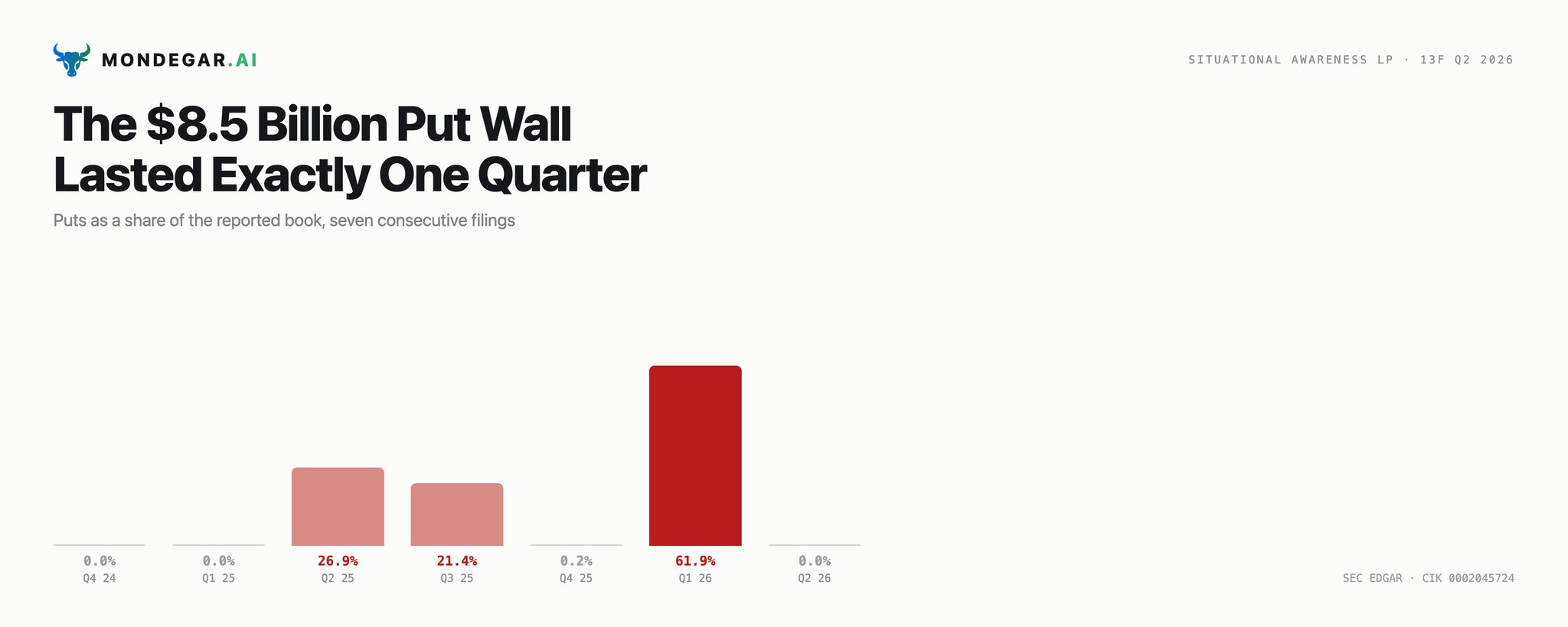
The fund has filed seven 13Fs. Puts as a share of the reported book run as follows: zero percent at December 2024, zero percent at March 2025, 26.9 percent at June 2025, 21.4 percent at September 2025, 0.2 percent at December 2025, 61.9 percent at March 2026, and 0.0 percent at June 2026.
The quarter immediately before the put wall had 0.2 percent of the book in puts. Whatever the March filing represented, it was not the continuation of a steadily building short.
"A position that was described as a thesis appears in the public record as a single quarter."
2. The book grew while the shorts came off
A fund closing a large bearish position under pressure would not normally be adding to its total exposure at the same time. This one did. The book went from 13.68 billion dollars to 20.24 billion, an increase of 48 percent in a single quarter.
The longer arc is steeper. Six quarters ago, at December 2024, the reported book was 250 million dollars. It is now 20.24 billion. That is an increase of roughly eighty times in eighteen months.
3. The new book is a memory bet
Of the 20.24 billion dollars reported at June, 11.25 billion sits in two memory names. Sandisk is the largest position in the fund at 5.674 billion dollars, up from 724 million three months earlier. Micron is second at 5.574 billion, up from a rounding error.
The rest is adjacent: Bloom Energy at 1.899 billion, Taiwan Semiconductor at 1.265 billion, Nebius at 1.233 billion, CoreWeave at 745 million, Core Scientific at 666 million, STMicroelectronics at 584 million, Applied Digital at 469 million and Riot Platforms at 468 million. Power, foundry, neoclouds and bitcoin miners with datacentre businesses.
4. The names it shorted and the names it now owns overlap
Micron carried a 584 million dollar put in March. It is a 5.574 billion dollar long in June. Taiwan Semiconductor carried a 542 million dollar put in March and a 1.265 billion dollar long in June. ASML, Nvidia, Oracle, Broadcom and AMD carried puts in March and do not appear in the June filing at all.
So the reversal is not evenly spread. On two names the fund moved from a disclosed bearish position to a large disclosed long. On five others it simply left.
5. Concentration went up, not down
Position count fell from 42 to 26. The top two names went from 12 percent of the book to 55.6 percent. Whatever else the filing shows, it is a smaller number of larger bets than the quarter before.
"Twenty six positions, and more than half the money is in two of them."
About the numbers we did not use
The obvious way to measure what a fund did is to subtract last quarter's dollar value from this quarter's. We do not do that, and on this filing the reason is easy to see.
Sandisk's reported value went from 724 million dollars to 5.674 billion. That is a change of 4.95 billion. But the share count only went from 1,140,119 to 2,495,344, and Sandisk's price per share at the two quarter ends was 635 dollars and 2,274 dollars. Most of that 4.95 billion is the stock going up, not the fund buying. Valuing the share delta at the quarter's own price gives about 3.08 billion of actual purchasing. The difference, roughly 1.87 billion dollars, is price movement wearing a trade's clothes.
We also checked the derived prices against the market. Every per-share figure implied by the filing matches the 30 June closing price to within a tenth of a percent, across five names and against a second, unrelated filer's report of the same securities. That is the check that tells you the arithmetic is reading the document correctly rather than confirming itself.
One more exclusion. Where a name appears as both a share position and an option position in the same filing, we keep them separate. A put's reported share count is the number of shares the contracts are written on, not shares owned, and adding the two together would produce a number that means nothing.
What this is actually for
A 13F is a quarterly snapshot of long positions in US-listed equities and options, filed up to 45 days after the quarter closes. It is now 14 August. The positions described here are as they stood on 30 June, six and a half weeks ago, and the fund has been free to change all of them since.
More importantly for this particular story: a 13F cannot show a short position. It shows puts, because puts are reportable securities, but a fund that is bearish through borrowed stock, swaps, non-US listings or simply by holding cash discloses none of that here. The honest statement is that the fund's disclosed bearish position is gone. Whether the fund is bearish is a different question, and this document cannot answer it.
The filing also cannot tell you whether the puts were closed or simply expired. Both produce the same result in the record: a share count that goes to zero.
This is a position report. It is not a trading signal, and the six and a half week lag alone should be enough to stop anyone treating it as one.
Note on the data
Source: SEC EDGAR, Situational Awareness LP, CIK 0002045724. Q2 2026, accession 0000935836-26-000418, filed 14 August 2026. Q1 2026, accession 0002045724-26-000008, filed 18 May 2026. The full history uses all seven of the fund's 13F filings, back to accession 0000935836-25-000120 for Q4 2024.
Method: flow is measured as the change in reported share count between adjacent quarters, valued at the later quarter's price per share as implied by the filing itself. Dollar-value differences are not used. Rows with an sshPrnamtType other than SH are excluded. Share positions, puts and calls are aggregated separately for each issuer and never netted against each other.
Amendments: none. All seven filings are original 13F-HR documents, so there is no restatement to resolve.
Entity scope: EDGAR lists four registrants with Situational Awareness in the name. Only CIK 0002045724 has filed a 13F with holdings. Situational Awareness Partners LP, Situational Awareness Offshore LP and the CGF2021 series entity have filed none, so there is no multi-entity aggregation question here. This matters because summing or comparing the wrong subset of a manager's entities is one of the most common ways 13F analysis produces enormous fake trades.
Corporate actions: every position whose share count changed by more than a factor of two was checked for splits, spinoffs and CUSIP changes. None were found in this filing pair.
Coverage: the figures above account for all 26 positions in the June filing and all 42 in the March filing.
A correction we would make to the common description of this fund: Situational Awareness is frequently characterised as a short seller. Nothing in seven 13F filings supports that as a standing description. Puts exceeded a fifth of the reported book in three quarters out of seven, and exceeded half in one.
www.mondegar.ai