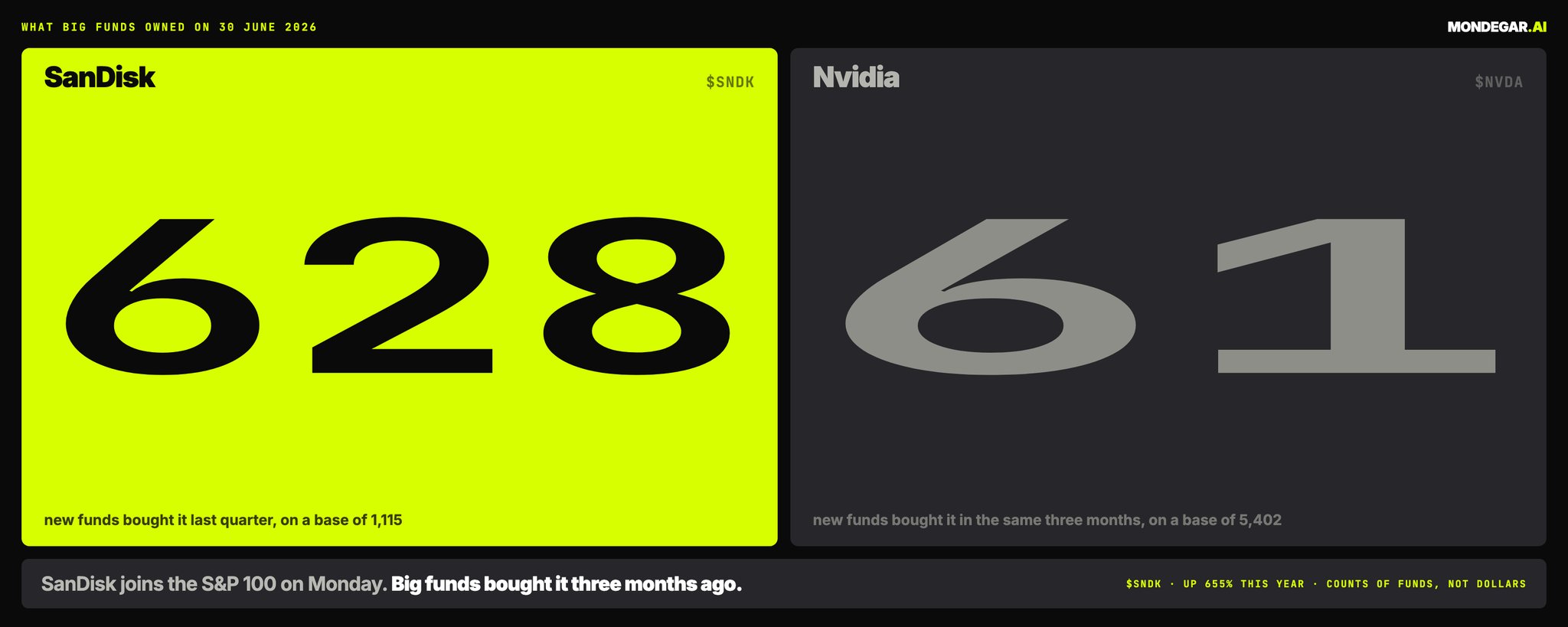
The stock is up 655 percent this year. Here is who was buying before the index change, and what it means if you own an index fund. The ticker is $SNDK.
WHAT HAPPENED
On Monday 21 September, SanDisk joins the S&P 100. S&P Dow Jones Indices announced it on 4 September. Dell, Palo Alto Networks and Arista Networks join at the same time. Nike, Colgate-Palmolive, Simon Property Group and Honeywell Aerospace drop out.
If you own an S&P 100 index fund, you will own SanDisk on Monday. You do not get a say in it.
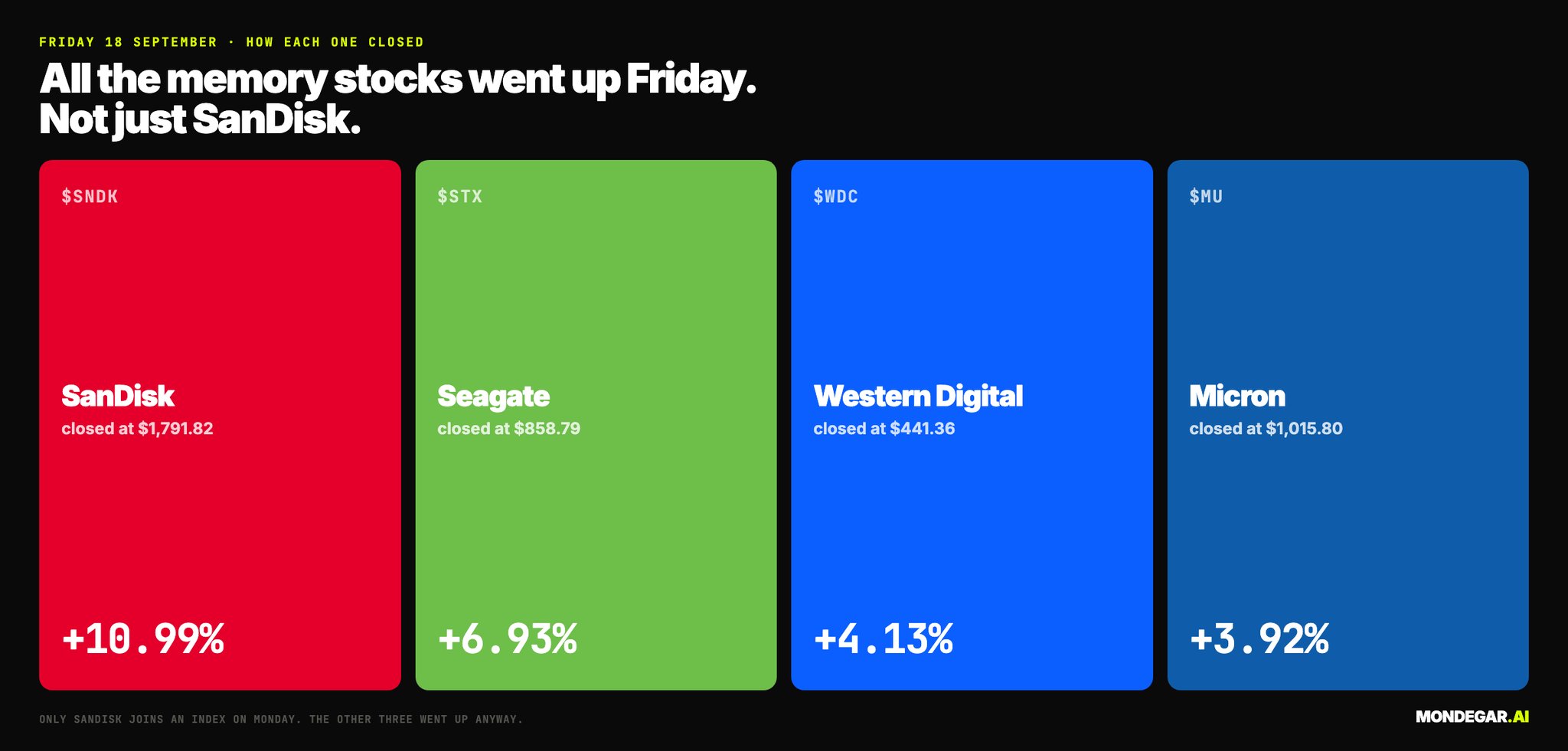
The stock closed Friday at 1,791 dollars and 82 cents, up 10.99 percent that day. It started the year at 237 dollars and 38 cents. That is a gain of 655 percent. Nothing else in the S&P 500 comes close.
Most articles this weekend say the stock went up because of the index change. That is not quite right, and here is the simple reason why.
SanDisk did not go up alone on Friday. Seagate rose 6.93 percent. Western Digital rose 4.13 percent. Micron rose 3.92 percent. None of those three is joining any index on Monday. The whole memory and storage group went up together.
So something bigger is going on.
WHO WAS BUYING
Big investors have to tell the public what they own every three months. We read all of those filings. Here is what changed between the end of March and the end of June.
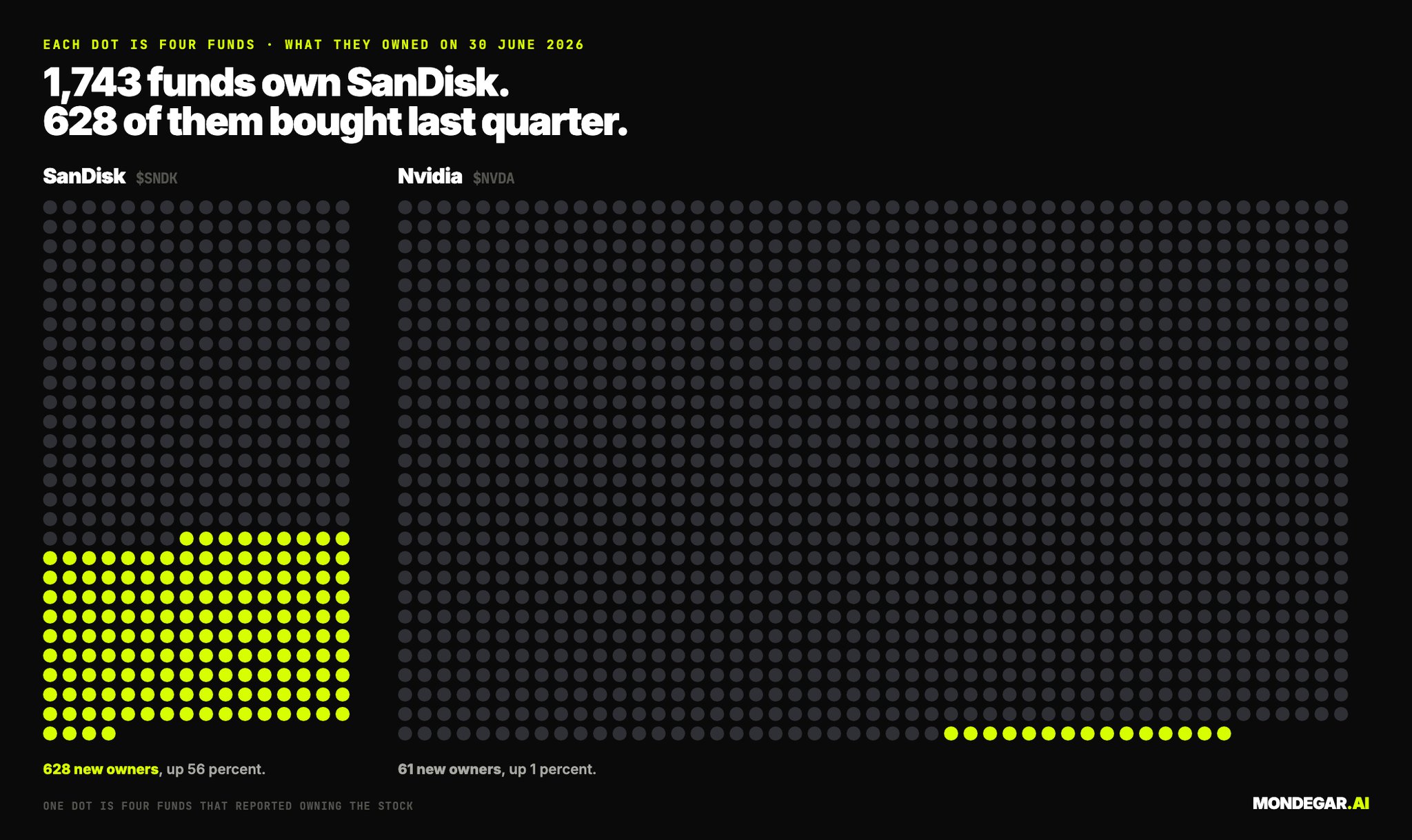
The number of funds that own SanDisk went from 1,115 to 1,743. That is 628 new owners in three months, a rise of 56 percent.
The same thing happened across the group. Seagate gained 34 percent more owners. Micron gained 31 percent. Western Digital gained 29 percent.
Now compare that with the two names everyone talks about. Nvidia added 61 new owners, a rise of 1 percent. Broadcom added 17, a rise of less than half a percent.
Big money did not leave the AI trade. It moved to the companies that make the memory and storage that AI chips need. And it moved three months before the index change.
IS THIS JUST A NEW STOCK PEOPLE ARE FINDING?
Fair question, and partly yes. SanDisk only started trading on its own in February 2025, after it split off from Western Digital. New stocks pick up owners naturally as funds get round to them. So some of that 56 percent is just that.
But Seagate has been listed since 2002. Micron since 1984. Western Digital since 1978. Nobody is finding those three for the first time, and they still gained 29 to 34 percent more owners in one quarter.
One more thing to be straight about. Nvidia already had 5,463 fund owners in June. When nearly every fund already owns something, the number cannot grow much further. Part of that 1 percent is simply that there is nobody left to buy it.
That is true. It is also the point. When everyone already owns a stock, the next dollar has to go somewhere else.
WHY THE MONEY MOVED
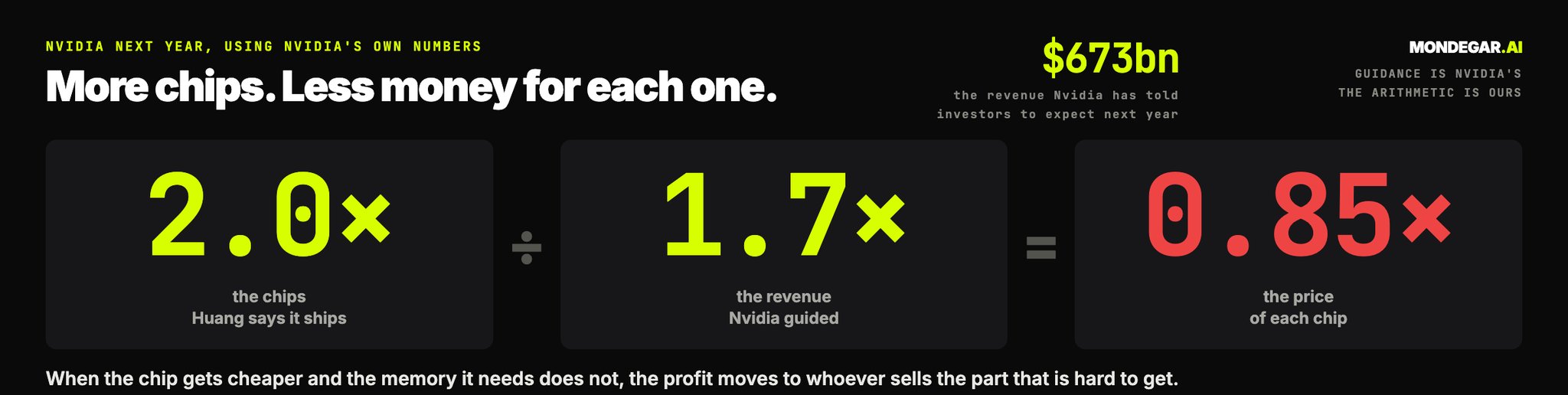
Jensen Huang said this week that Nvidia will sell twice as many chips next year. Nvidia has told investors to expect revenue to grow about 70 percent, to roughly 673 billion dollars.
Put those two numbers together.
If you sell twice as many chips but collect only 1.7 times the money, then the price of each chip falls about 15 percent.
That is not a problem for Nvidia. It is what happens when you scale up. But it tells you where the profit goes next. If the chip gets cheaper and the memory it needs does not, the money moves to whoever sells the part that is hard to get.
That is what those fund filings are showing, before it turns up in the news.
ONE THING NOBODY IS MENTIONING
SanDisk closed Friday at 1,791 dollars and 82 cents. Its highest close in the past year was 2,335 dollars. So the stock joining the S&P 100 on Monday is still 23 percent below its own high.
The index change is not arriving at a cheap moment. It is arriving after a 655 percent year, with the stock 23 percent off its peak, in a name big funds spent the spring buying.
Index buying is automatic. Funds that track the S&P 100 have to buy on Monday whatever the price is. That is real money and it is part of why Friday moved. It is not anyone saying the stock is good value.
WHAT THIS MEANS FOR YOU
Three things.
You may already own it. If you hold an S&P 100 or S&P 500 fund, this trade is in your portfolio whether you picked it or not, and you get more of it on Monday. Check what your funds actually hold before you decide to buy more.
Watch what is scarce, not what is famous. The question in AI is no longer who makes the best chip. It is which part is in short supply. Fund ownership is one honest way to see where professional money thinks the answer is, and right now it points at memory and storage. You can look up the owner counts for any stock at mondegar.ai.
Know what this data is not. These filings show what funds owned on 30 June. They come out weeks later, so they are always about three months behind. They tell you what big investors did. They do not tell you what they are doing today, and none of this is advice to buy anything.
Big funds got to SanDisk three months before the index did. That does not make them right. It does make them worth watching.
Owner counts are the number of institutional managers reporting a position, from quarterly filings for the periods ending 31 March and 30 June 2026. We count funds rather than dollar amounts, because a dollar amount goes up when the share price goes up even if nobody bought a single share. Prices are closing prices. The index change is from the S&P Dow Jones Indices announcement of 4 September 2026. You can check any of these figures at mondegar.ai.