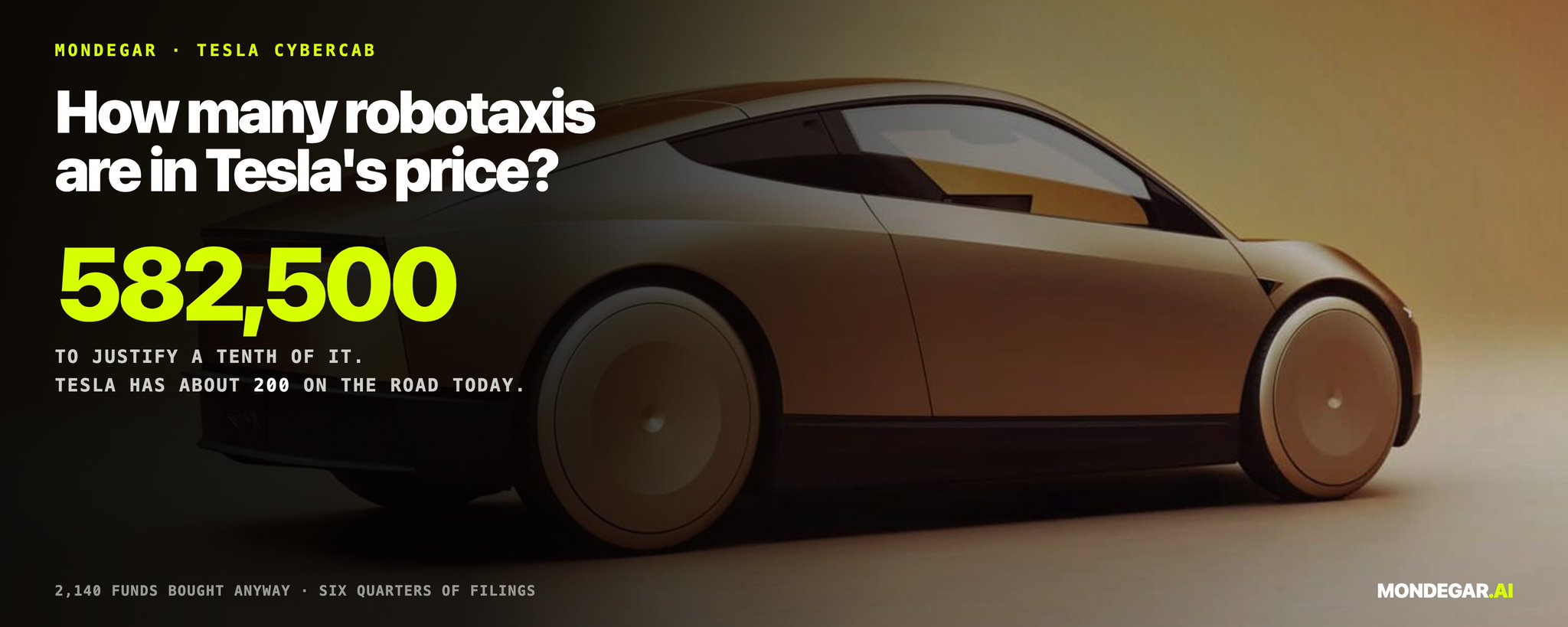
582,000 of them, to justify a tenth of it. Tesla has about 200 on the road today. Two thousand funds bought anyway.
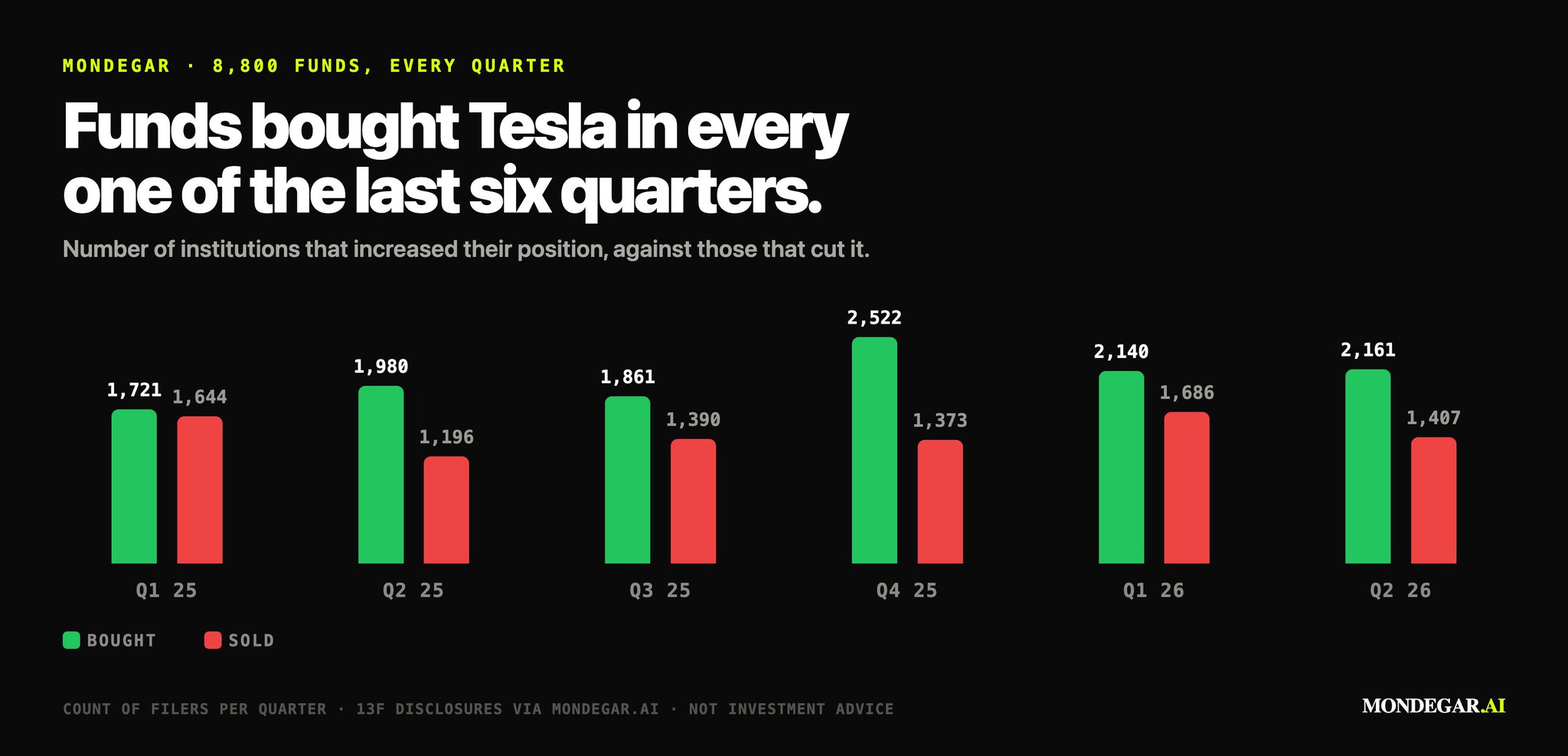
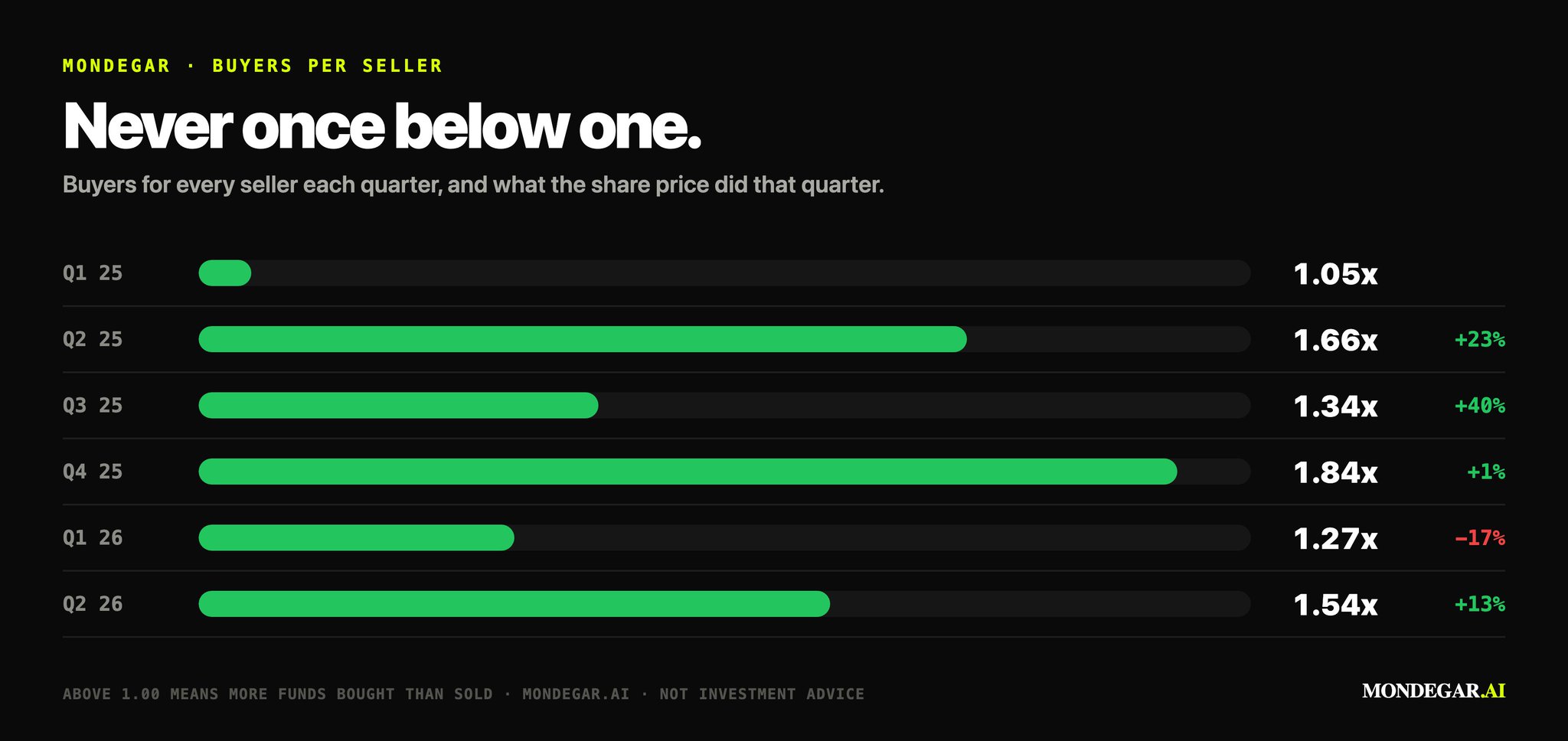
More funds bought the fall than sold it. And that was not the exception. Across the last six quarters, buyers have outnumbered sellers every single time, in a range from 1.05 to 1.84 buyers for every seller.
That is the whole thing in two sentences. The detail is worth the read, because the obvious explanation is wrong.
THE OBVIOUS EXPLANATION IS WRONG
The easy answer is index funds. Tesla sits in the S&P 500, money flows into index products, the funds buy mechanically and the count means nothing.
It does not hold. Mechanical buying does not produce a ratio that swings from 1.05 to 1.84 and back to 1.27. Index flows are steady. What we are looking at moves with something, and it does not move with the share price.
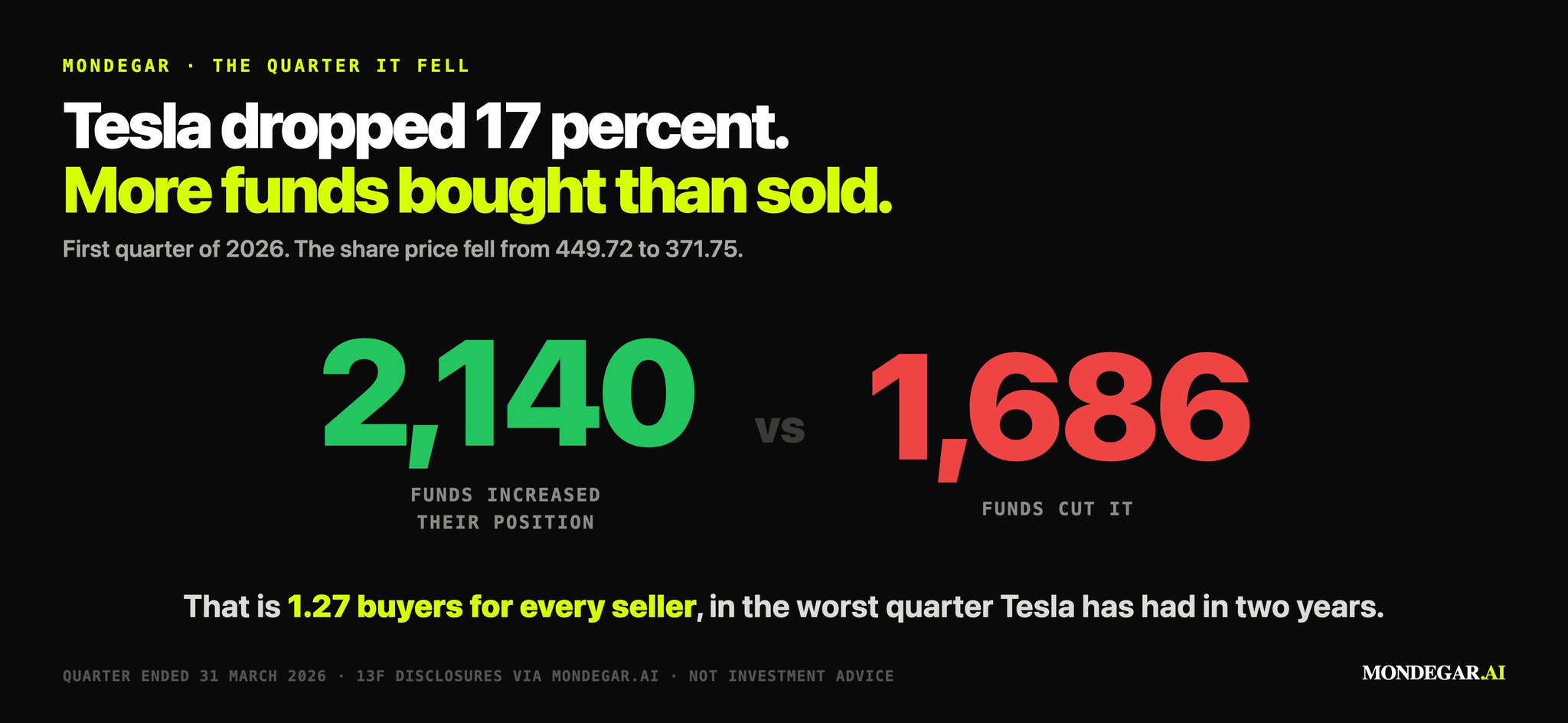
Look at the two together. In the quarter Tesla rose 40 percent, 1,861 funds bought. In the quarter it fell 17 percent, 2,140 funds bought. More of them bought the bad quarter than the good one.
Whatever these institutions are pricing, it is not this year's deliveries.
WHAT THEY ARE ACTUALLY PRICING
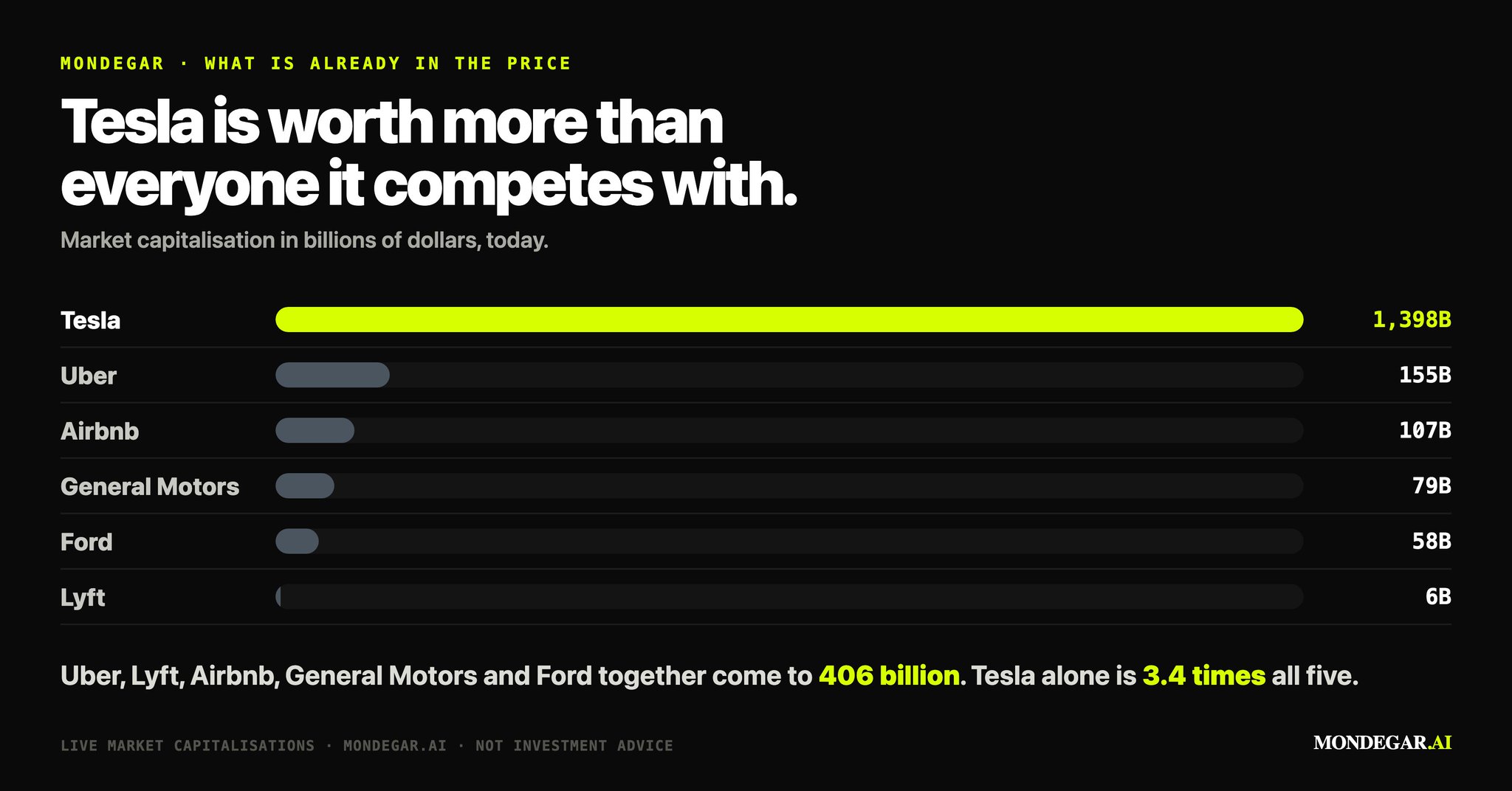
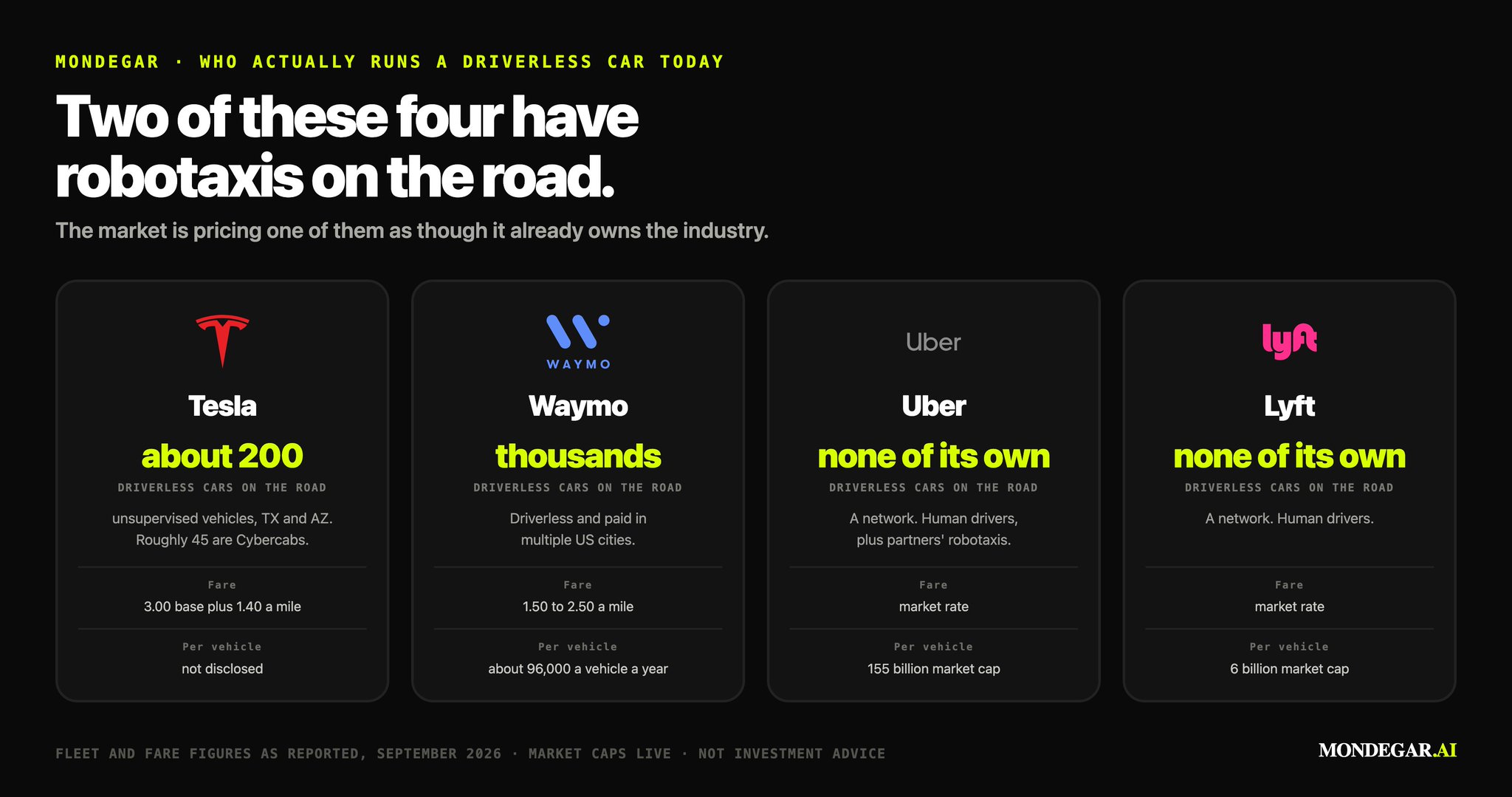
Tesla is worth 1,398 billion dollars today. Uber and Lyft together, which is the entire listed ride hailing industry in the United States, are worth 161 billion. Tesla is 8.7 times the whole industry it has not entered yet.
You cannot get to that number by selling cars. General Motors and Ford together are worth 138 billion, and between them they sell far more vehicles than Tesla does. If the market were valuing Tesla as a car company it would be priced like one.
So the market is already paying for the robotaxi. The only question worth asking is how many of them are in the price.
THE ARITHMETIC ON ONE DRIVERLESS CAR
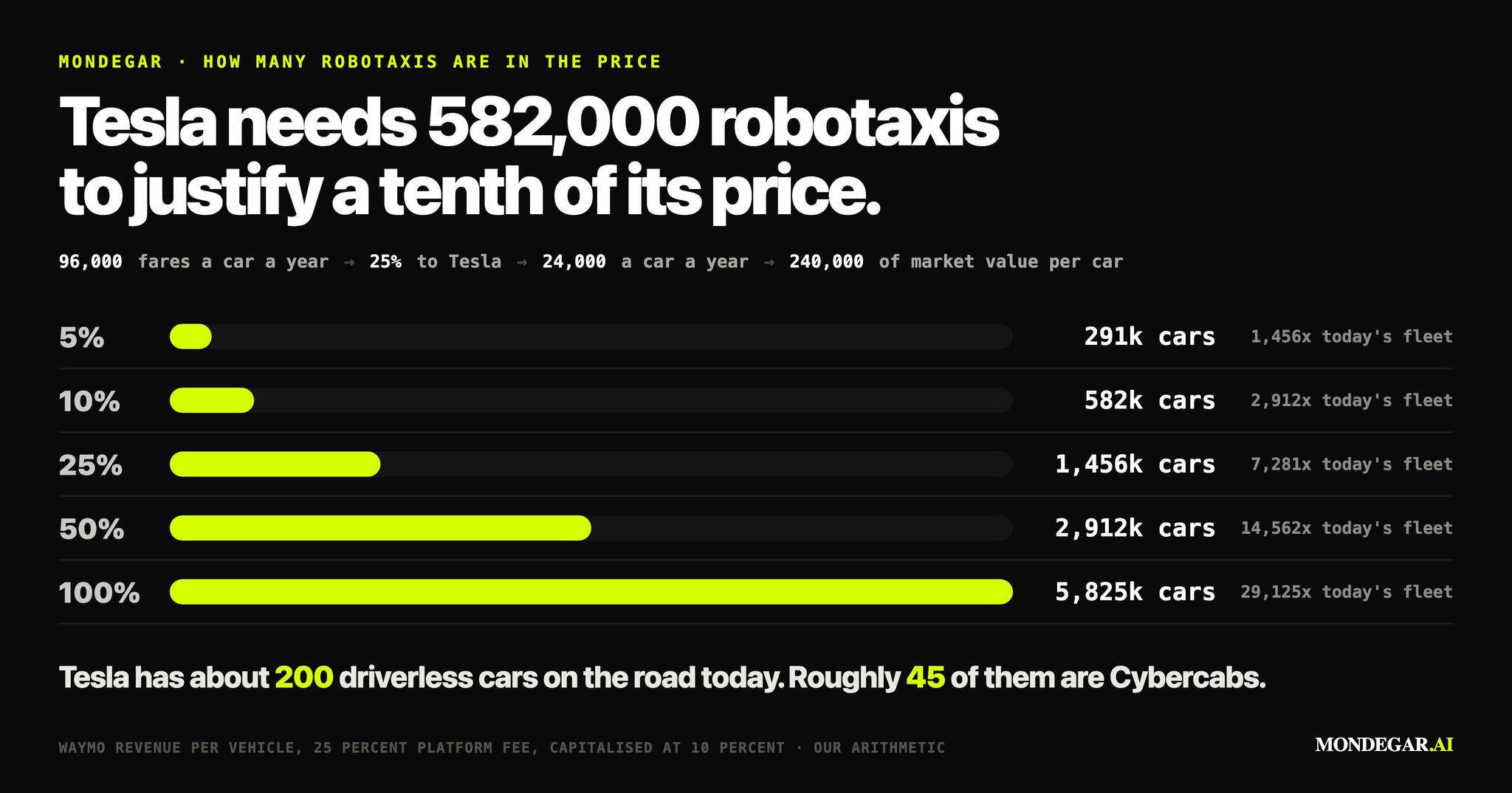
Waymo already runs driverless taxis today and brings in roughly 96,000 dollars a year per vehicle. Tesla takes a platform fee of about 25 percent on fares run through its network.
So every robotaxi on the road is worth about 24,000 dollars a year to Tesla. Capitalise that at 10 percent and each car carries about 240,000 dollars of market value. Four lines, and anyone can check them.
HOW MANY ARE IN THE PRICE
To justify one twentieth of Tesla's value you need about 291,000 driverless cars earning fares. One tenth needs 582,500. A quarter needs 1.46 million. Half needs 2.9 million.
Tesla has about 200 unsupervised vehicles on the road today, across Texas and Arizona. Roughly 45 of them are Cybercabs, and the service launched commercially in Austin on 3 September 2026.
So a tenth of today's price requires about 2,900 times the fleet that currently exists.
THE INFLECTION POINT, AND HOW TO SPOT IT
Everything above is a stock. This is the thing you can actually watch. The gap is not the interesting part. The rate of change is.
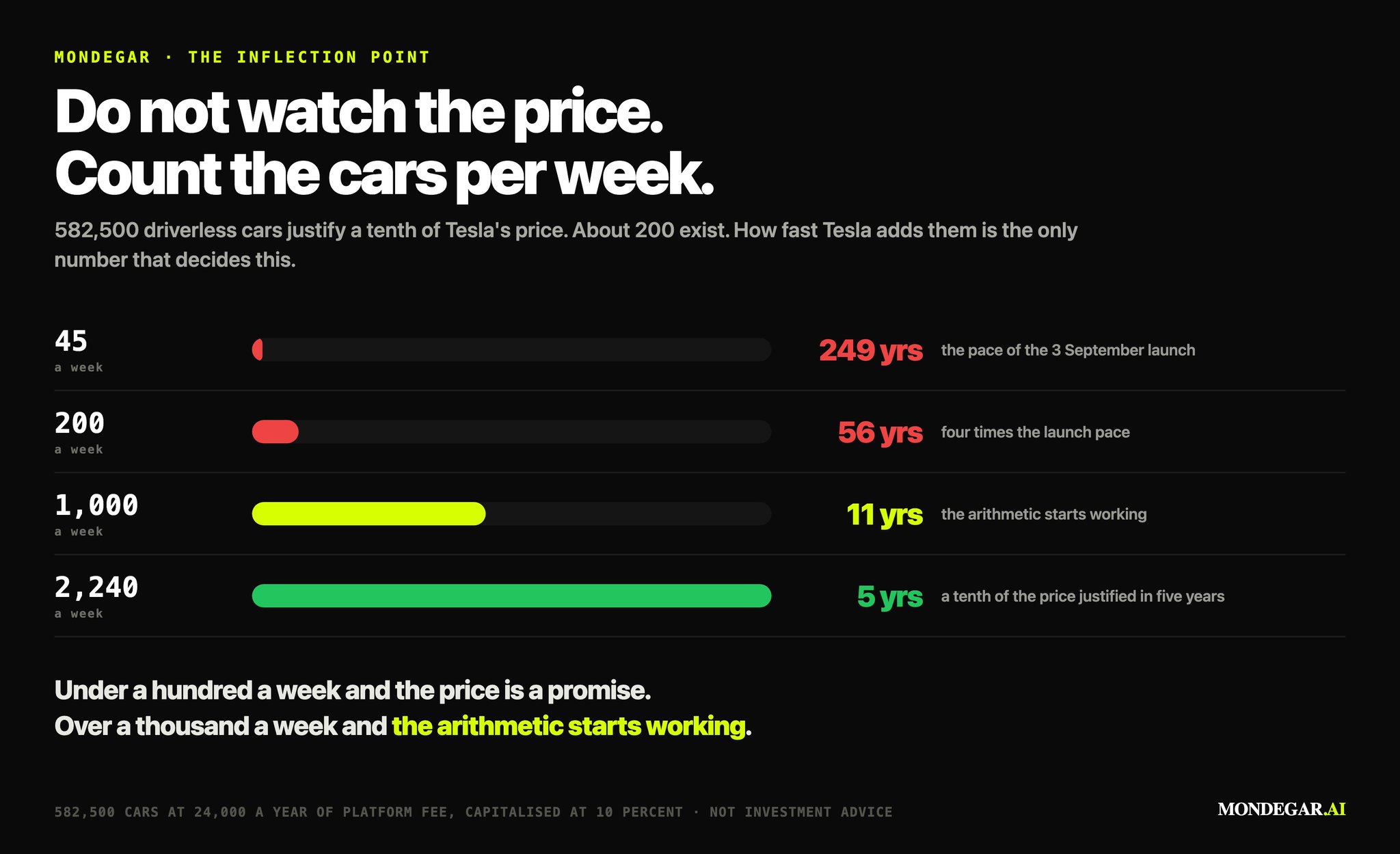
Work backwards. To close that gap in five years Tesla has to put about 2,240 cars on the road every week. In ten years, 1,120 a week. Those are the two numbers worth memorising.
Now measure the present against them. At the pace of the September launch, roughly 45 a week, the gap never closes in a human lifetime.
That is not a criticism. It is what the start of an S curve looks like from the bottom. Every fleet business in history has looked ridiculous at 45 units.
So the inflection point is not a date, and it is not a product launch. It is the week the number stops being tens and starts being thousands. Watch the weekly additions. Under a hundred a week and the price is a promise. Over a thousand a week and the arithmetic starts working.
Two things gate it, and both are checkable. Tesla has no driverless permit in California, which is the largest market in the country. And the fare has to hold near current levels as supply arrives, because cheap autonomy is exactly what drives fares down.
WHY THE FUNDS BOUGHT THE FALL
If you believe the fleet arrives, a 17 percent drop in the share price is not bad news. It is the same asset at a lower price, and the thing you are buying is a decade out. You buy more.
If you do not believe it, you are holding a car company trading at eight times the entire ride hailing industry, and you should have sold long ago.
The filings say 2,140 institutions took the first view and 1,686 took the second, in the worst quarter Tesla has had in two years.
THE ONE FUND THAT SAYS IT OUT LOUD
Most institutions never explain themselves. A 13F shows you what they did and never why. One firm is the exception.
Cathie Wood's ARK Invest held about 1.16 billion dollars of Tesla at the end of the second quarter, and carries a 2029 target of 2,600 dollars a share against roughly 354 today. Their published model runs a 2,000 dollar bear case and a 3,100 dollar bull case.
The target is not the interesting part. Forecasts that far out are usually wrong. The composition is. ARK estimates that close to 90 percent of Tesla's enterprise value and earnings by 2029 come from robotaxis.
Ninety percent. One firm has put a number on exactly what the other two thousand are doing without comment. And ARK behaved the way the thesis demands, buying into the falls through 2026 rather than trimming.

WHAT AN INVESTOR SHOULD TAKE FROM THIS
First, stop reading Tesla through deliveries. The institutions stopped six quarters ago. Quarterly delivery numbers move the share price for a week and have not moved institutional positioning at all.
Second, the number to follow is cars added per week, and after that the fare per mile. Fares fall when supply arrives, and cheap autonomy is exactly what brings supply.
Third, know which side of the trade you are on. At 1,398 billion dollars you are not being offered a carmaker at a fair price. You are being offered a fleet that does not exist yet, priced as though a good part of it already does.
THE HONEST SCOREBOARD
A 13F is a photograph taken two months ago. The most recent filings cover 30 June. Tesla has fallen roughly 16 percent since then, and we cannot see what those funds did in July or August.
The counts are the reliable part of this data and the dollars are not. In the same six quarters the reported net dollar flow swings from plus 18.6 billion to minus 33.0 billion to plus 30.3 billion, which tells you about the share price rather than about behaviour.
The buyer counts also include index and quantitative funds that hold Tesla for reasons that have nothing to do with robotaxis. We think the swing in the ratio argues against that being all of it. We cannot prove it.
And every robotaxi figure is arithmetic, not experience. Nobody has run this fleet at scale, including Tesla.
WHAT WE USED
Institutional counts from 13F disclosures filed with the SEC, covering 8,800 filers across six quarters to 30 June 2026, processed by Mondegar.ai. Share prices are quarterly closes. Market capitalisations are live. Waymo revenue per vehicle and fare ranges from published reporting. A 25 percent platform fee and a 10 percent discount rate are our assumptions. Fleet counts as reported in September 2026.
See what every tracked fund owns, and what changed last quarter, at www.mondegar.ai
Not investment advice.